Music Theory / Chapter
Notation of Notes, Clefs, and Ledger Lines
- A note conveys both pitch and rhythmic duration.
- Notes are notated on a staff, where vertical placement corresponds to pitch: higher-frequency (shorter-wavelength) sounds are written higher, and lower-frequency (longer-wavelength) sounds are written lower.
- The notehead must be rendered with precision: it is oval in shape (not circular), of proportionate size, and slightly inclined upward to the right.
- Stems may extend upward from the right side of the notehead or downward from the left. By convention, notes above the middle line take downward stems, notes below the middle line take upward stems, and notes on the middle line may take either direction depending on contextual considerations.
- In the notation of seconds, one notehead is laterally displaced. The lower notehead is consistently placed to the left, irrespective of stem direction.
- A clef establishes the pitch assignments of the lines and spaces of the staff.
- Ledger lines are short auxiliary lines used to extend the staff above or below its standard range.
Western musical notation emphasizes two primary elements: pitch and rhythm. Pitch is represented along the vertical axis, while rhythm is organized along the horizontal axis. This system is read from left to right and from top to bottom, in a manner analogous to reading a page of written English.
Notes structure
A note indicates both pitch and rhythm. Each note consists of a notehead (either empty or filled in) and may also have a stem and a beam or flag. Feature 1. shows an illustration of noteheads, stems, beams, and flags:
A note represents both pitch and rhythmic duration. Each note includes a notehead (which may be either hollow or filled) and can also incorporate a stem along with a beam or flag.
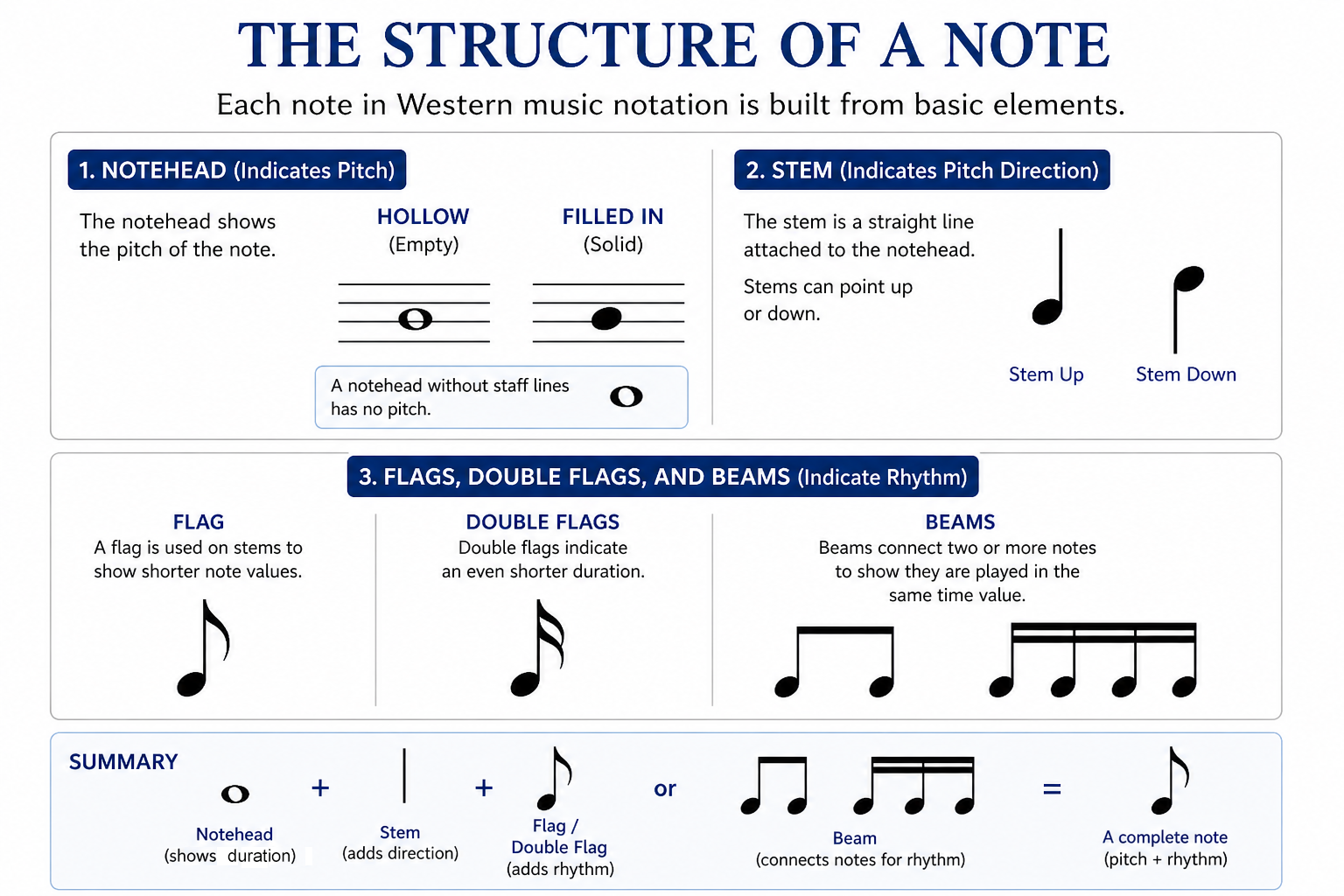
Feature 1. presents an illustration of noteheads, stems, beams, and flags.
Staff Notation
A staff (plural “staves”) is essential for conveying pitch. A staff consists of five horizontal lines, evenly spaced, and each note is placed on the line or space that corresponds to its pitch. Feature 2. depicts a staff:
 Feature 2. A staff.
Placing Notes on a Staff
Noteheads on a line should fill in half of each space above and below. Noteheads in a space should just touch the lines above and below. Feature 3. shows examples of correct noteheads, both open and filled in, both on lines and in spaces:

Noteheads should be oval (not round), and they are tilted slightly upward toward the right. Feature 4. shows incorrect noteheads. As you can see, noteheads can be drawn too small, too big, or the wrong shape. - mostly, computer generated musical notes have correct sizes and positions, but hand writings can be incorrect. so, you can see below the correct one which can be easily identifiable, and also an incorrect example of it.

Stems and Beams
The stems of notes can point either upward (on the right side of a note) or downward (on the left side of a note). For notes above the middle line, the stem points downward, and for notes below the middle line, stems point upward. Notes on the middle line can point in either direction, depending on the surrounding notes. This is shown in feature 5:

Stemming directions and beaming conventions are discussed more in Simple Meter and Time Signatures and Compound Meter and Time Signatures. When hand-drawing stems, their length is equal to four lines of the staff. Beams are about four times thicker than stems.
You can practice stemming directions by dragging and dropping in the following exercise: