Music Theory / Chapter
Introduction to Musical Notation Invention
How Was Musical Notation Invented? A Brief History
This lesson explores the evolution of musical notation from simple memory aids to the complex system used today. It highlights that notation wasn't a single invention, but a centuries-long refinement process.
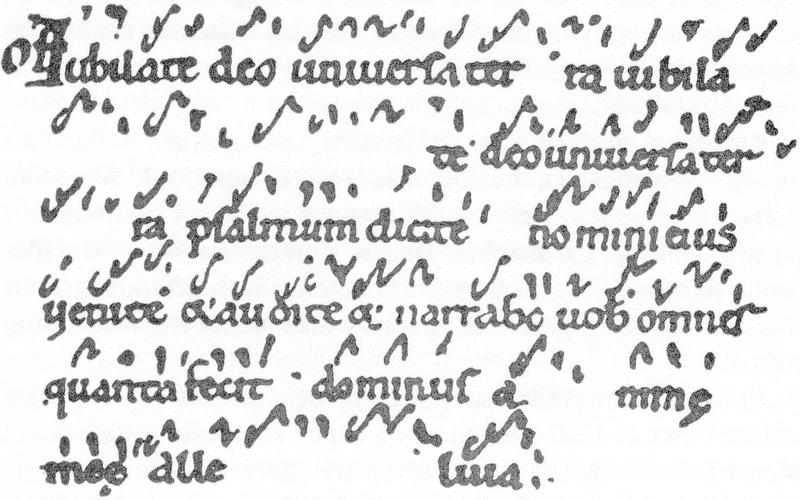
Feature 1. Text from the chant "Iubilate deo universa terra."
Note the neumes that appear above the words.
Key Milestones in Musical Notation
-
Pre-1025: Neumes, Feature 1, Before formal staves, monks used neumes—marks above text that indicated the general "contour" of a melody (rising or falling) rather than specific pitches. This required singers to already know the tune by heart.
-
1025: Guido of Arezzo and the Staff Guido of Arezzo revolutionized music by inventing the four-line staff.
He used colored lines (yellow for C, red for F) to provide fixed pitch references.
This allowed singers to perform music they had never heard before.
He is also credited with organizing pitches into hexachords and inventing solfege ("do-re-mi").
-
The Rise of Mensural Notation As music became more complex, composers needed a way to dictate rhythm. Mensural notation introduced symbols for note durations, such as:
Longas and Breves (the ancestors of modern long notes).
Mensural signs, which functioned like modern time signatures to define the relationship between different note values.
-
17th Century to Modern Day With the rise of instrumental music, notation evolved further to include:
Five-line staves.
Barlines, stylized clefs, and dynamic markings.
Technical instructions like ties and slurs to guide instrumentalists.
Why Notation Matters
Above summary concludes that notation is a "complex language" that allows composers to communicate intricate creative ideas—from the counterpoint of Bach to modern funk—ensuring that music can be preserved and performed accurately across generations.
Next question is:
How familiar are you with reading sheet music, or are you more interested in the historical side of how these symbols evolved?