Music Theory / Chapter
Major Scales, Scale Degrees, and Key Signatures
- A major scale consists of seven distinct notes arranged in a set order of whole (W) and half (H) steps: W-W-H-W-W-W-H.
- The name of a major scale is determined by its starting note, along with any sharp or flat attached to it; this same note also serves as the scale's final point.
- Each step of the scale can be identified using either Roman numerals (I - II - III - IV - V - VI - VII) or Arabic numerals (1 - 2 - 3 - 4 - 5 - 6 - 7), with each number corresponding to a particular solmization syllable.
- Solfège, in addition to numbers, you can use the syllables do, re, mi, fa, sol, la, and ti to label the different pitches of a major scale.
- Beyond numbers and syllables, every note in a major scale has a specific functional title: tonic, supertonic, mediant, subdominant, dominant, submediant, and leading tone.
- Located at the start of a piece of music, a key signature is a group of sharps or flats placed between the clef and the time signature.
- To navigate key signatures, remember the set orders: F-C-G-D-A-E-B for sharps and B-E-A-D-G-C-F for flats. The tonic is located a half step higher than the very last sharp, or it is the second-to-last flat listed.
- The circle of fifths serves as a handy diagram for memorizing major key signatures, organizing them around a circle based on how many sharps or flats they contain.
Major Scales
A major scale consists of seven notes arranged in a set order of whole (W) and half (H) steps: W-W-H-W-W-W-H.
To create the bright sound of a major scale, apply the formula W-W-H-W-W-W-H to a series of ascending pitches.
Listen to "C major scale" below to hear an ascending major scale. Each whole step is labeled with a square bracket and “W,” and each half step is labeled with an angled bracket and “H.”
악보 데이터를 불러오는 중...
Every major scale begins and ends on the same note name, spanning exactly one octave; this specific note provides the scale's title, which is why a scale starting and finishing on C is known as C Major.
You can practice identifying half steps and whole steps in a major scale in the following exercise:

Identify the following interval in the major scale as a half step or a whole step.
A scale’s name must include any sharp or flat attached to its starting and ending note. For example, a B♭ major scale is distinct from a B major scale because they use entirely different sets of notes, even though both follow the exact same sequence of whole and half steps.
악보 데이터를 불러오는 중...
Frequently utilized across diverse musical landscapes, the major scale is notably present in the 2008 song 'Love Story' by Taylor Swift, specifically as a descending E major scale degree in the final excerpt.:
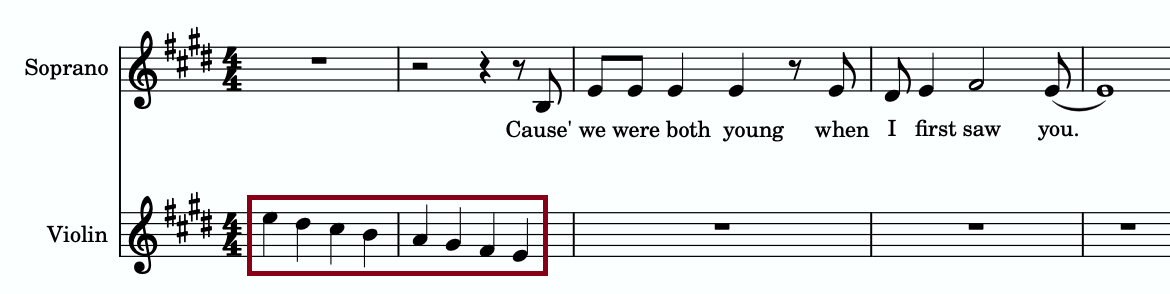
To hear the descending E major scale in action, skip to 0:10 in the clip. You'll hear the violin play the scale downward right before the singer enters.
Listen to the Example starting at 0:10
You can practice identifying major scales in the following exercise:

Identify the following major scale:
Scale Degrees, Solfège, and Scale-Degree Names
Musicians have various ways to name scale notes. The D major scale in the illustration uses Roman numerals to identify each position. Additionally, solfege corresponds to the Roman numerals.
악보 데이터를 불러오는 중...
The syllables do, re, mi, fa, sol, la, and ti provide a melodic naming system for the first seven notes of a scale, returning to do for the final note. In a movable do system, do is flexible and changes based on the key, unlike fixed do, where do is always tied to the pitch class C.
You can practice matching major key signatures with solfège solmization syllables in the following exercise:
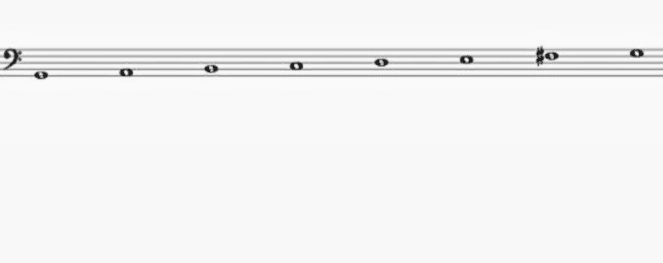
Major scale solfege matching in the bass clef:
To understand the role of each note, musicians use specific names—such as subdominant or submediant. These names, along with their numerical and solfège counterparts, are organized for comparison in feature 6.
| Scale Degree Number | Solfège | Scale Degree Name |
|---|---|---|
| I | do | Tonic |
| II | re | Supertonic |
| III | mi | Mediant |
| IV | fa | Subdominant |
| V | sol | Dominant |
| VI | la | Submediant |
| VII | ti | Leading Tone |
| VIII/I | do | Tonic |
feature 6. Scale-degree numbers, solfège syllables, and scale-degree names.
feature 7 shows these scale-degree names applied to an A♭ major scale:
악보 데이터를 불러오는 중...
Feature 8 shows the notes and scale-degree names of the Db major scale in an order that shows how the names of the scale degrees were derived. The curved lines above the staff show the generic interval between each scale degree and the tonic.
- The word dominant is inherited from medieval music theory, and refers to the importance of the fifth above the tonic in diatonic music.
- The word mediant means "middle," and refers to the fact that the mediant is in the middle of the tonic and dominant pitches.
- The Latin prefix super means “above,” so the supertonic is a second above the tonic. This is the only "super-" interval.
- The Latin prefix sub means “below;” the subtonic, submediant, and subdominant are the inverted versions (i.e., below the tonic) of the supertonic, mediant, and dominant respectively. (Note that the leading tone is a half step below the tonic, while the subtonic is a whole step below the tonic.
악보 데이터를 불러오는 중...
You can practice matching scale degrees, solfège solmization, and scale-degree names of major keys in the following exercise:
Which solfège syllable corresponds to the leading tone in a major scale?
Key Signatures
A key signature is a set of sharps or flats placed at the start of a piece of music, positioned between the clef and the time signature. A helpful trick to remember this sequence is that it follows alphabetical order: Clef, Key, Time. You can see this layout in Feature 9, where the key signature is sandwiched between the bass clef and the meter.
How Key Signatures Work
Purpose: Instead of writing accidentals next to every single note, key signatures group them at the beginning of the staff. This makes the music cleaner and easier to read.
Global Application: In Feature 9, the flats are placed on the lines and spaces for B, E, and A. This means that every B, E, and A in the entire piece must be played as a flat.
Octave Rule: This rule applies to every octave. For example, in Feature 10, any B on the staff—whether high or low—is played as a B♭ because it is included in the key signature.
Order Musical Element Memory Aid 1st Clef C 2nd Key Signature K 3rd Time Signature T


Key signatures follow a strict, unchanging sequence for adding both sharps and flats, regardless of which clef you are using. Feature 11 illustrates this standard order across the four most frequently used clefs.
Alternative Phrasings
The Universal Approach: "The specific sequence in which sharps and flats are added to a key signature remains the same across all clefs. You can see how this consistent order is notched into the treble, bass, alto, and tenor clefs in feature 11."
The Rule-Based Approach: "Whether you are writing in a sharp or flat key, the accidentals must be placed in a fixed, predetermined order. This rule applies universally to any clef, as demonstrated in the examples in feature 11."
The Instructional Approach: "To correctly write a key signature, you must follow the set order for sharps and flats shown in feature 11. This order never changes, no matter which of the four common clefs you are reading."
Common Clefs Reference
As you might recall from your work with choral scores or music theory, these "four most common clefs" typically refer to:
Treble Clef (Soprano/Alto voices, Violin, Piano RH)
Bass Clef (Tenor/Bass voices, Cello, Piano LH)
Alto Clef (Viola)
Tenor Clef (Cello/Bassoon high registers)

The sequence of sharps follows a fixed pattern—F, C, G, D, A, E, B—which is often memorized using the phrase, "Fat Cats Go Down Alleys Eat Birds." Visually, these sharps zig-zag up and down on the staff. In most clefs (treble, bass, and alto), this pattern shifts slightly after D♯ to stay within the lines, while in the tenor clef, the first two sharps are simply placed in a lower octave to keep the pattern consistent.
The sequence of flats is the exact reverse of the sharps: B, E, A, D, G, C, F, creating a musical palindrome. You can remember this order with the mnemonic, "Birds Eat And Dive Going Copiously Far." Unlike sharps, flats always maintain a perfect, alternating zig-zag pattern across all clefs, as illustrated in feature 11.
To quickly identify a major key from its signature, you can use these simple rules:
For Sharp Keys: Look at the very last sharp on the right; the tonic (the name of the scale) is exactly one half-step above that note.
Example: Feature 12 provides three examples of sharp key signatures across various clefs to demonstrate how this "half-step up" method works.
Comparison of the Two Orders
Type Order Mnemonic Example Sharps F - C - G - D - A - E - B Fat Cats Go Down Alleys Eat Birds Flats B - E - A - D - G - C - F Birds Eat And Dive Going Copiously Far

feature 13 shows three flat key signatures in different clefs. Here's how to identify each with this method:

In the image provided, you can identify the major key by looking at the sharp furthest to the right and moving up one half-step:
G Major: Since $F\sharp$ is the only sharp (and therefore the last one), you move up a half-step to find the tonic, G.
A Major: The final sharp in this sequence is $G\sharp$. One half-step above $G\sharp$ is A, identifying this as A major.
F# Major: Here, the last sharp is $E\sharp$. Moving up a half-step from $E\sharp$ brings you to $F\sharp$, which is the name of the key.
For keys that use flats, the rule changes: the second-to-last flat in the signature is the tonic. Feature 13 demonstrates this method across three different clefs:
The Rule: Simply look at the group of flats and pick the one immediately to the left of the final flat.
The Tonic: That specific note name tells you exactly which major scale you are in.
Exception: Remember that F Major (which has only one flat, $B\flat$) doesn't have a "second-to-last" flat, so that one must be memorized independently.

Feature 15 displays the key signature for C major (which contains no accidentals), followed by the complete sequence of sharp keys—G, D, A, E, B, F♯, and C♯ major—presented across the four standard clefs.

feature 15. The key signatures of C, G, D, A, E, B, F♯, and C♯ in all four clefs.
Feature 16 illustrates the C major key signature (which has no sharps or flats), followed by the complete sequence of flat keys—F, B♭, E♭, A♭, D♭, G♭, and C♭ major—as they appear in all four standard clefs.

Feature 16 begins with the accidental-free key signature of C major, followed by the full progression of flat keys—F, B♭, E♭, A♭, D♭, G♭, and C♭—displayed across all four standard clefs.
Helpful Memory Shortcuts
To simplify your memorization, keep these "C" keys in mind as your anchors:
C Major: The neutral starting point with zero accidentals.
C♭ Major: The "all flat" key, featuring a total of 7 flats.
C♯ Major: The "all sharp" key, featuring a total of 7 sharps.
"Real" vs. "Imaginary" Keys
Real Keys: These are the standard keys found in Features 15 and 16 that use only single sharps or flats.
Imaginary Keys: A key is considered "imaginary" if its theoretical key signature would require double sharps ($\sharp\sharp$) or double flats ($\flat\flat$).
Example: As shown in Feature 17, F♭ major is an imaginary key because its signature would require a B double-flat ($B\flat\flat$). While you might occasionally see these in complex musical passages, they are not part of the standard set of key signatures.
악보 데이터를 불러오는 중...
You can practice identifying major key signatures in the following exercise:
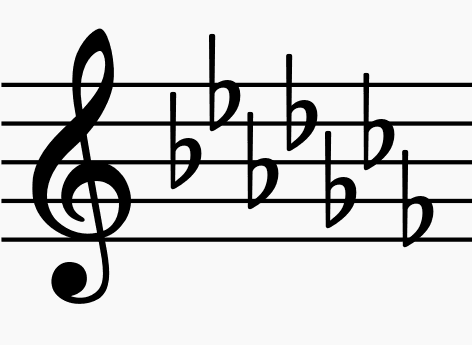
Identify the above major key signature.
The Circle of Fifths
The circle of fifths is a practical graphic that organizes every major key signature into a circular layout based on the number of sharps or flats they contain. Its name comes from the fact that each key on the circle is separated from its neighbors by the interval of a fifth. You can see this visual representation of major keys in feature 18.

Positioned at the very top of the circle (12 o’clock) is C major, which contains no accidentals. Moving clockwise from this point introduces sharp keys, with each step adding one additional sharp to the signature. Conversely, traveling counter-clockwise from C major introduces flat keys, increasing the count by one flat at each position.
Key Points of Interest
The Progression: The circle logically builds in complexity, moving from zero accidentals at the top to the maximum number at the bottom.
Enharmonic Equivalence: The three key signatures at the bottom of the circle (7, 6, and 5 o'clock) represent the same sounding pitches despite having different names.
Example: The B major scale (5 sharps) and the C♭ major scale (7 flats) sound identical to the ear because B and C♭ are enharmonically equivalent notes, even though their written notation and key signatures look very different.
Position Sharp Key Flat Key Sound 7 / 5 o'clock B Major (5#) C♭ Major (7b) Same 6 o'clock F♯ Major (6#) G♭ Major (6b) Same 5 / 7 o'clock C♯ Major (7#) D♭ Major (5b) Same
You can practice matching major key signature names with the circle of fifths in the following exercise:
Circle of Fifths Matching (Major Scales)
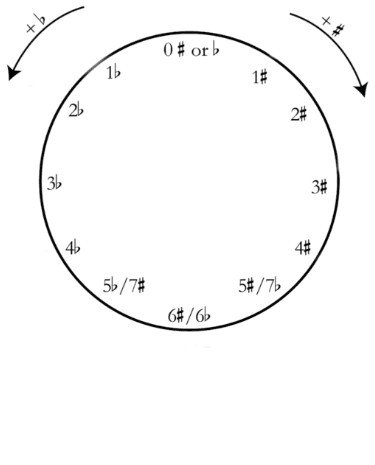
스마트폰: 버튼을 탭한 뒤, 원안의 매칭되는 임시표의 갯수를 박스에 배치하세요.